
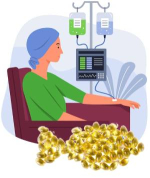
 Omega 3-vetzuren worden vaak nog als controversieel beschouwd bij chemotherapie. Zo gold er in Nederland lang een tegenadvies, gebaseerd op één ‘fishy’muizenstudie. Met verwaarlozing van vele positieve wetenschappelijke studies, én de vaststellingen in Japan dat veel Omega 3 bij chemotherapie voordelig is, en niet leidt tot chemoresistentie.
Omega 3 verlaagt niet alleen algemeen het kankerrisico, ook bij diverse kankerssoorten (borst-, darm-, baarmoederhals-, longkanker) is bescherming aangetoond, o.a. tegen de bijkomende ongewenste neveneffecten van zowel kanker als kankertherapie. Een hoge dosis Omega-3 blijkt te beschermen tegen door chemotherapie veroorzaakte ontsteking, maar ook tegen het extreme verlies van gewicht en spiermassaverlies (cachexie).
Sinds 2021 adviseert ESPEN* mensen met gevorderde kanker die chemotherapie ondergaan visolie te suppleren om eetlust, spiermassa en lichaamsgewicht te stabiliseren of te verbeteren.
*ESPEN: de gezaghebbende European Society of Clinical Nutrition and Metabolism
Referenties:
Muskiet F. Visolie tijdens chemotherapie: goed of slecht? https://www.mmv.nl/columns/visolie-tijdens-chemotherapie-goed-of-slecht/
Mazurak VC, Calder PC, van der Meij BS. Let Them Eat Fish. JAMA Oncol. 2015 Sep;1(6):840.
Baracos V. Let Them Eat Fish. JAMA Oncol. 2015 Sep;1(6):840-1.
Murphy RA, Clandinin MT, Chu QS, Arends J, Mazurak VC. A fishy conclusion regarding n-3 fatty acid supplementation in cancer patients. Clin Nutr. 2013 Jun;32(3):466-7.
Molfino A et al. Re-evaluating omega-3 (EPA/DHA) in cancer prevention and management.
Opin Clin Nutr Metab Care. 2026; 29(2):141-147.
Szlendak M, Kapała A. Does the ratio of eicosapentaenoic acid to docosahexaenoic acid matter in cancer treatment? A systematic review of their effects on cachexia-related inflammation. Nutrition. 2024; 124:112466.
Lu H, Zhang Z, Liu F.Comparison of EPA and DHA&EPA on body weight, BMI, and lean body mass in cancer patients: a network meta-analysis. Support Care Cancer. 2025 Nov 25;33(12):1125.
Chen W et al. Inverse association between eicosapentaenoic acid and incident colorectal cancer: a dose-response meta-analysis of twenty-six independent prospective cohorts. Eur J Nutr 2025; 64:221.
Dierge E et al. Peroxidation of n-3 and n-6 polyunsaturated fatty acids in the acidic tumor environment leads to ferroptosis-mediated anticancer effects. Cell Metab. 2021; 33(8):1701-1715.e5.Press release – UCLouvain research. An Omega-3 that’s poison for tumours. https://uclouvain.be/en/discover/press/news/an-omega-3-that-s-poison-for-tumours.html
Bron: ABC Gezondheid